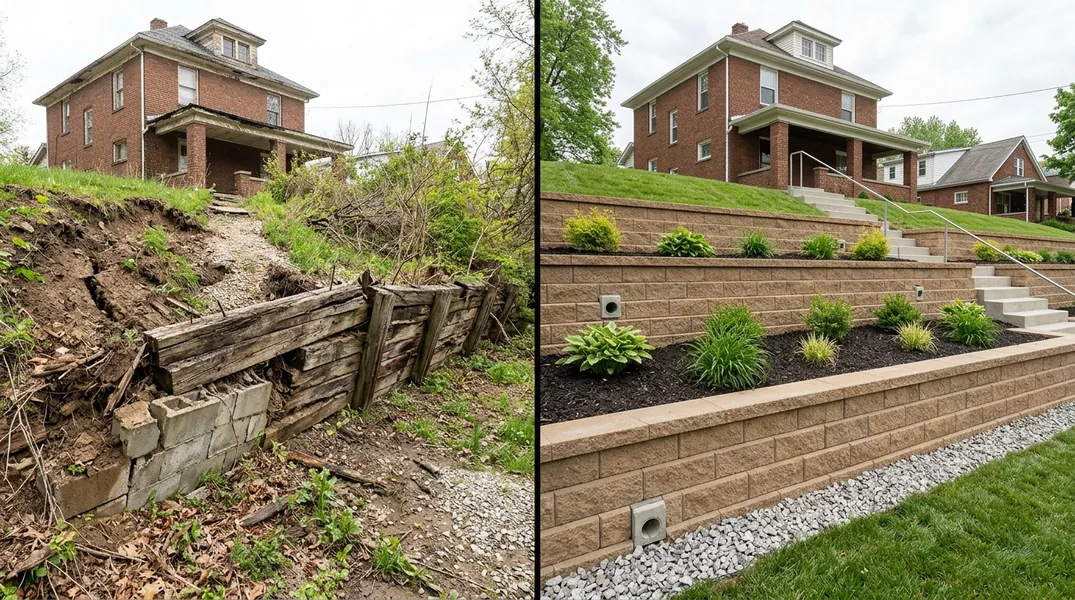
The Black Swamp Clay Under Your Toledo Yard: A Tough Foundation for Any Wall
If you live in Toledo, you may have heard the phrase "Black Swamp" in local history. That old swamp left behind a legacy of heavy, dense clay soil that still sits under many neighborhoods today. This clay is not just a gardening nuisance. It is the single biggest reason retaining walls in the area fail years before their time.
Black swamp clay has two habits that work against a retaining wall. First, it drains very slowly, so water from rain and snowmelt sits against the wall instead of moving away. Second, it expands when wet and shrinks when dry, which means it pushes and pulls on the wall with every season. A wall that was built without accounting for these forces will start to lean, bow, or crack much sooner than the homeowner expects.
Warning Signs of a Failing Retaining Wall
The good news is that retaining walls almost never fail without warning. They give you clues first, and those clues are easy to spot once you know what to look for. A leaning retaining wall is the most obvious sign. Step back and look at the wall from the end. If the top is tipping away from the soil it holds back, the wall is already under stress and needs attention.
A bowing retaining wall is another clear red flag. Bowing shows up as a gentle curve in the middle of a straight wall, usually because water pressure has built up behind it. You should also check for stair-step cracks in block walls, horizontal cracks in concrete, and soil settling at the base. Any of these signs means it is time to call a professional for a proper assessment. Catching a bowing retaining wall fix early is far cheaper than waiting for a collapse.
Why DIY Repairs and Cheap Builds Backfire on Clay Soil
Many homeowners try to patch a failing wall with a fresh coat of paint, some new blocks, or a quick backfill. On sandy soil, these shortcuts sometimes hold for a while. On black swamp clay, they rarely do. The real problem is almost always drainage and base preparation, and neither one can be fixed from the surface. A wall that looks patched but still sits on a shallow, poorly drained base will keep moving.
This is why proper Retaining Wall Repair starts underground. A qualified crew will inspect the footing, check the drainage behind the wall, and look at the soil conditions before recommending a fix. In some cases, a targeted repair is enough. In others, the honest answer is that Retaining Wall Replacement will cost less over time than repeated patches. A good contractor will tell you which one you actually need.
How to Build a Retaining Wall That Survives Toledo's Seasons
The right way to build on clay is to plan for water from day one. That means a deep, compacted gravel base, a proper drainage layer behind the wall, and weep holes or drainage pipe to move water out. It also means using materials and wall designs that can handle the push of saturated clay without shifting. Shortcuts in any of these steps are exactly what leads to a leaning retaining wall a few winters later.
Material choice matters too. Concrete Retaining Walls are a popular option in the area because they handle heavy soil pressure and freeze-thaw cycles well. Block and timber walls can work too, but they need extra care in the design and drainage. If you are planning a new wall, professional Retaining Wall Installation is the best way to make sure it is built for the soil you actually have, not the soil in a generic how-to video.
Retaining Wall Repair Near Me: When to Call a Pro
If you are searching for retaining wall repair near me in Sylvania or anywhere around Perrysburg, the safest rule is simple: call when you first notice movement. A wall that leans even slightly is already under pressure, and that pressure does not go away on its own. Waiting for a visible collapse usually means emergency work, higher costs, and possible damage to your yard, driveway, or home.
A professional inspection will tell you whether the wall can be stabilized or needs to come down. You will get a clear picture of the cause, the options, and what each one involves. If you are not sure whether your wall is in trouble, it is worth having someone look at it before the next heavy rain season. Reach out for a free estimate and get an honest answer about what your wall needs.
Retaining Wall Repair Cost in Toledo: What to Budget
Homeowners often ask what a repair will run before they call anyone, and that is a fair question. The truth is that pricing depends on several factors: the height and length of the wall, how much movement has already happened, the condition of the base, and whether drainage needs to be rebuilt. A small bowing retaining wall fix on a low garden wall is a very different project from stabilizing a tall wall holding back a driveway.
Because of that, the most useful step is a site visit. A contractor can look at the soil, the drainage, and the wall itself, then give you a realistic range instead of a guess. Budgeting for a proper repair now is almost always less expensive than replacing a collapsed wall later. Call Toledo Retaining Wall at (419) 574-6333 to schedule an inspection and get clear numbers for your specific wall.
Looking for a professional retaining wall contractor in Toledo? Toledo Retaining Wall responds fast for all your retaining wall needs.
Get a Free QuoteOur services: Retaining Wall Installation · Retaining Wall Repair · Retaining Wall Replacement