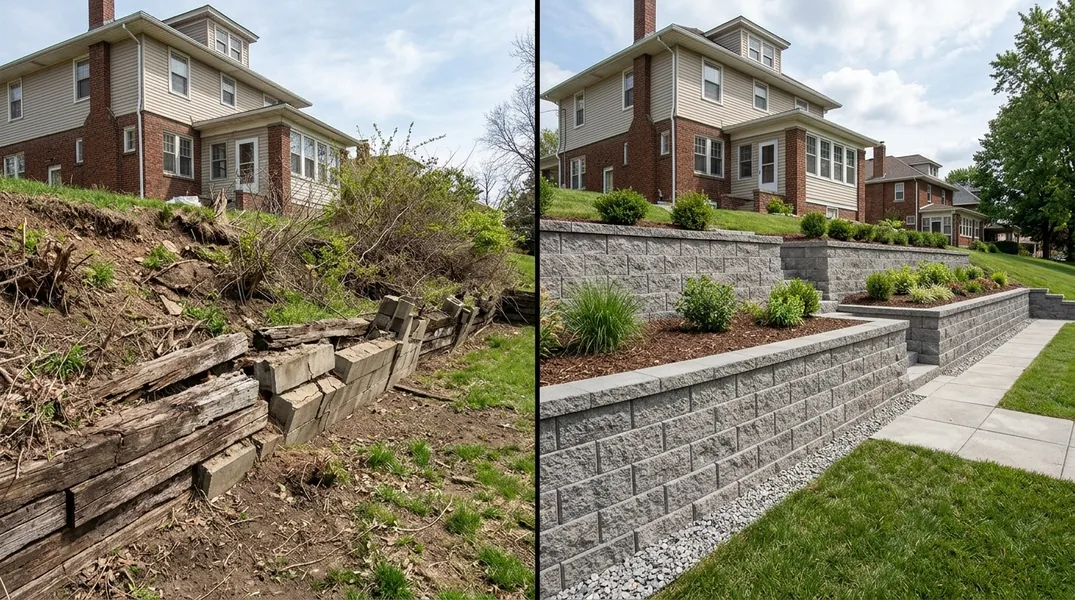
Why Retaining Walls Lean and What It Means for Your Property
A leaning retaining wall is one of the most common calls we get from homeowners in Toledo. The wall may have looked solid for years, and then one spring you notice the top has started to tip outward, or a crack has opened up along the face. Before you panic, it helps to understand what is actually happening behind the scenes. Most leaning walls are the result of soil pressure that has exceeded what the wall was designed to handle, often combined with water that cannot drain away fast enough. When the soil behind the wall becomes saturated, it gets heavier and pushes harder. Over time, that pressure can cause the wall to rotate, bow, or settle unevenly.
In our region, freeze and thaw cycles make this worse. Water seeps into the soil and into small cracks, freezes, expands, and then thaws, leaving the wall slightly weaker each season. A wall that leans just an inch or two may still be stable, but a wall that has moved several inches or is visibly bulging is telling you something important. Ignoring a leaning wall is rarely a good idea because the problem tends to accelerate. The good news is that not every leaning wall needs to be torn out and rebuilt. In many cases, a targeted Retaining Wall Repair can stabilize the structure and extend its life for years.
Signs You Can Repair Instead of Replace
If your wall is leaning but the movement is minor and the wall itself is still largely intact, repair is often the smarter and more economical choice. Small cracks that have not widened significantly, slight tilting at the top, and localized settling at the base are all issues that a professional can address without a full rebuild. In many cases, the fix involves improving drainage behind the wall, regrading the soil, and reinforcing the existing structure. Sometimes we can reset a section of the wall or add drainage aggregate and a proper outlet to relieve the pressure that caused the lean in the first place.
It is also worth knowing that Concrete Retaining Walls are often good candidates for repair because the material itself is durable and does not rot or degrade like timber. If the concrete is sound and the problem is mostly about movement or drainage, repair can be a practical solution. The key is catching the issue early. A wall that has leaned a few inches over several years is a very different situation from a wall that moved several inches in a single season. We always recommend a professional inspection so you know exactly what you are dealing with before you spend money on a fix that may not hold.
When Replacement Is the Safer Choice
There are clear situations where repair is not worth the risk. If the wall is severely bulging, has large horizontal or stair-step cracks, or if the base has shifted significantly, the structural integrity may already be compromised. A wall that is holding back a steep slope or supporting a driveway or patio carries more risk, and a failure could damage your home, your landscaping, or a neighbor's property. In those cases, a full Retaining Wall Replacement is usually the safer and more cost-effective decision over the long run. Rebuilding gives you the chance to install proper drainage, use the right materials for the load, and correct any grading issues that caused the original failure.
We also see older timber walls that have rotted to the point where repair is not realistic. Wood walls have a limited lifespan, and once the timbers are soft or the posts have given way, replacement is the only reliable option. During a replacement, we can also improve the design so the new wall handles water better, which is especially important in our climate. Homeowners in Sylvania and nearby areas often choose to upgrade to a newer, more durable system at the same time. If you are unsure which path makes sense, a professional assessment will give you a clear answer rather than a guess.
Retaining Wall Crack Repair: What Homeowners Should Know
Cracks are one of the first warning signs homeowners notice, and they are also one of the most misunderstood. A hairline crack in a concrete wall is often cosmetic and may simply be the result of normal curing or minor settling. A wider crack, especially one that runs horizontally or forms a stair-step pattern in block walls, is a different story. Those patterns usually indicate movement, and movement is what you need to address. Patching a crack without fixing the underlying cause is like putting a bandage on a leaky pipe: it may look better for a while, but the problem will return. Proper Retaining Wall Repair looks at the whole system, including drainage, backfill, and the wall's footing.
In some cases, crack repair involves sealing the crack and then reinforcing the wall so it does not move further. In other cases, the crack is a symptom of a larger issue that requires a more involved fix. We always tell homeowners to watch for cracks that are widening, cracks that appear alongside leaning, and cracks that let water through during heavy rain. Any of those signs means it is time to have the wall looked at by a professional. The earlier you act, the more options you have, and the less likely you are to face an emergency repair after a storm.
Finding Retaining Wall Repair Near Me in Toledo
If you are searching for retaining wall repair near me in the Toledo area, the most important thing is to work with a company that understands local soil and weather conditions. Our freeze and thaw cycles, clay-heavy soils, and spring runoff all put extra stress on retaining walls. A contractor who works in other regions may not account for those factors. A local team will know how to design drainage, select materials, and build a wall that performs through our winters. That local knowledge is often the difference between a repair that lasts and one that fails again in a few years.
Whether you need a small repair or a full rebuild, the first step is a professional inspection. We offer a free estimate so you can understand your options and make a confident decision. If you are in Perrysburg or Maumee, we serve those areas as well. You can reach Toledo Retaining Wall at (419) 574-6333 to schedule a visit, or visit our website to learn more about our services and pricing. Do not wait until a leaning wall becomes a collapsed wall. A quick call today can save you a much larger project later.
Looking for a professional retaining wall contractor in Toledo? Toledo Retaining Wall responds fast for all your retaining wall needs.
Get a Free QuoteOur services: Retaining Wall Installation · Retaining Wall Repair · Retaining Wall Replacement