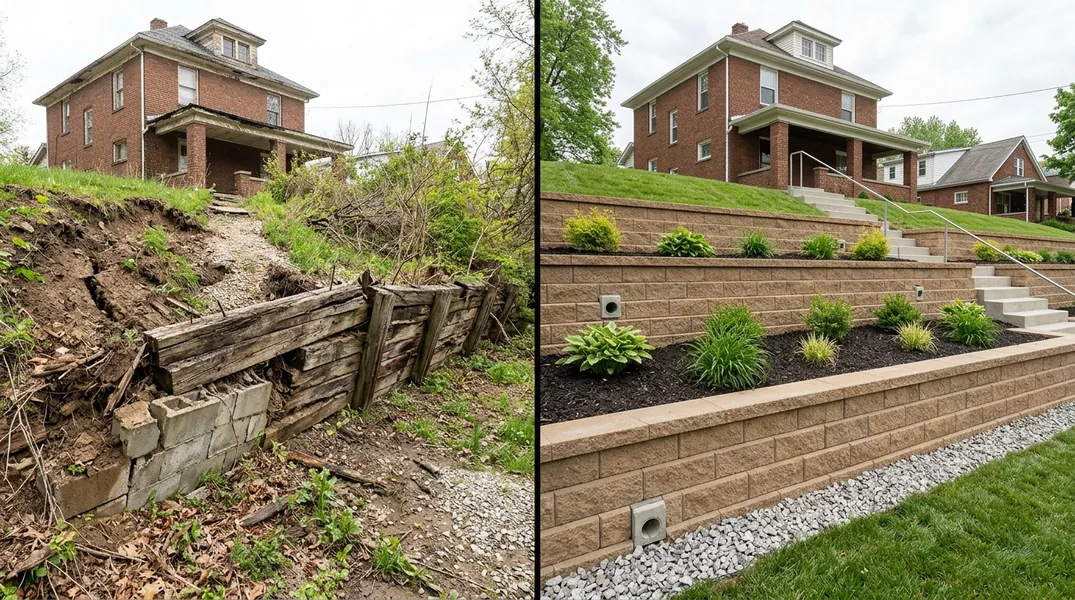
Why Toledo's Spring Thaw Is Hard on Retaining Walls
Spring in Toledo brings a predictable but destructive cycle: frozen ground thaws from the top down, snowmelt and rain saturate the soil, and water has nowhere to go. For retaining walls, this is the most dangerous time of year. When the ground freezes, water trapped behind a wall expands and pushes the structure forward, a process called frost heave. As it thaws, that same water turns the backfill into a heavy, saturated mass that exerts enormous pressure on the wall face.
Most retaining wall failures we see in Toledo start with water, not with the blocks or the concrete. Homeowners often notice a slight lean, a bulging section, or cracks that seem to appear overnight after a wet spring. By the time these symptoms are visible, the drainage system behind the wall has usually been compromised for months or years. Understanding how water moves through your soil is the first step toward protecting your investment and avoiding a full Retaining Wall Replacement.
Hydrostatic Pressure: The Silent Force Behind Wall Failure
Hydrostatic pressure is the force exerted by water that cannot escape. Behind every retaining wall, there is a column of soil. When that soil becomes saturated, the water fills the voids between particles and pushes outward in all directions. A wall designed to hold back dry soil may face double or triple the load once that soil is waterlogged. In Toledo's flat, clay-heavy soils, water drains slowly, so the pressure lingers long after the rain stops.
This is why Retaining Wall Installation done without proper drainage is a gamble. Even the strongest Concrete Retaining Walls can crack or tip when hydrostatic pressure builds up behind them. The fix is not thicker concrete or bigger blocks; it is a drainage system that collects water and carries it away before it can accumulate. Without that relief, the wall is fighting a losing battle against physics.
How a Retaining Wall French Drain Prevents Costly Damage
A retaining wall french drain is the most effective defense against hydrostatic pressure and frost heave. This system typically consists of a perforated pipe wrapped in filter fabric and surrounded by washed gravel, installed at the base of the wall behind the backfill. Water enters the pipe through the perforations and flows by gravity to a daylight outlet or a storm drain. When designed correctly, the french drain keeps the water table behind the wall low, reducing pressure and preventing the soil from becoming a saturated, heavy mass.
In Toledo's freeze-thaw climate, the details matter as much as the concept. The drain must be sloped properly, the gravel must be clean and free of fines, and the filter fabric must be correctly overlapped to prevent clogging. We also recommend free-draining backfill and weep holes at regular intervals to handle any water that bypasses the drain. If your existing wall shows signs of poor drainage, such as water pooling at the base or soil washing out through the face, a Retaining Wall Repair that addresses the drainage is often more economical than waiting for a collapse.
Frost Heave and Flood Season: What Toledo Homeowners Should Watch For
Frost heave does not just affect the wall itself; it also moves the soil and anything resting on it. In Sylvania and Perrysburg, we often see walls that survived years of dry summers fail after a single wet spring because the freeze-thaw cycle opened cracks and loosened the soil. Warning signs include horizontal cracks, a wall that leans more each season, bulging in the middle, and soil settling behind the top course. If you notice any of these, have the wall evaluated before the next freeze.
Flood season adds another layer of risk. When the ground is already saturated, heavy rain cannot infiltrate, so it runs along the surface and finds the path of least resistance, often directly into the backfill behind your wall. This is why homes in low-lying areas of Maumee and near drainage corridors need extra attention. A professional assessment can determine whether your wall needs a new french drain, additional weep holes, or a more comprehensive repair. For pricing on drainage upgrades and repairs, call Toledo Retaining Wall at (419) 574-6333.
Retaining Wall Drainage Near Me: When to Call a Professional
If you are searching for retaining wall drainage near me, you are probably seeing symptoms that worry you. While small surface cracks can sometimes be patched, drainage problems are rarely solved from the outside. The real fix requires digging out the backfill, inspecting the drain, and correcting the slope and materials. This is heavy, precise work that demands an understanding of local soil conditions and freeze-thaw behavior. Attempting a partial fix often makes the problem worse by disturbing the soil without restoring the drainage path.
A professional evaluation will tell you whether your wall needs a targeted repair, a new drainage system, or replacement. It is also the best way to protect your home's value and avoid emergency costs later. Toledo Retaining Wall serves homeowners across the region with drainage-focused installations and repairs. To schedule a free estimate, call (419) 574-6333 or visit the website. A short conversation now can save you from a collapsed wall after the next spring thaw.
Looking for a professional retaining wall contractor in Toledo? Toledo Retaining Wall responds fast for all your retaining wall needs.
Get a Free QuoteOur services: Retaining Wall Installation · Retaining Wall Repair · Retaining Wall Replacement