Why Northwest Ohio's Clay and High Water Table Change Everything
If you live in Toledo or anywhere across Northwest Ohio, you already know that our soil is not like the sandy, well-drained ground you see in other parts of the country. The region is dominated by heavy, dense clay that holds water like a sponge after every rainstorm. Combine that with a water table that often sits surprisingly close to the surface, and you have a recipe for hydrostatic pressure that can push, bulge, or outright topple a poorly chosen retaining wall.
This matters because the material you select is not just about looks. A wall that performs beautifully in a dry climate may fail within a few seasons here if it cannot handle saturated soil and freeze-thaw cycles. The best materials for this region share a few traits: they resist moisture intrusion, they can be installed with proper drainage, and they offer enough mass or interlock to stand up to pressure from behind. Understanding those traits before you shop will save you thousands in repairs down the road.
Concrete Retaining Walls: The Heavyweight for Saturated Soil
Concrete Retaining Walls are often the first choice for Northwest Ohio homeowners dealing with clay and a high water table, and for good reason. Poured or precast concrete delivers serious mass, and mass is your best defense against hydrostatic pressure. A properly engineered concrete wall can be designed with weep holes, drainage gravel, and a footing that reaches below the frost line, which is critical in our climate where the ground freezes and thaws repeatedly through winter.
The tradeoff is cost and flexibility. Concrete walls typically require more excavation and a longer installation timeline, and they are harder to modify once poured. However, for tall walls, walls holding back a slope near a foundation, or any situation where the soil stays wet for long stretches, concrete is hard to beat. If you are weighing options and want to understand how concrete compares on pricing, a professional assessment of your specific slope and drainage conditions is the smartest starting point.
Block Retaining Walls and Segmental Systems: Versatile and Drain-Friendly
A Retaining Wall Installation using a block retaining wall system has become one of the most popular choices in the Toledo area, and it is easy to see why. Segmental retaining walls are built from interlocking concrete blocks that stack without mortar, and many systems are specifically engineered to flex slightly under pressure rather than crack. That flexibility is a real advantage in clay soil that expands and contracts with the seasons.
Segmental retaining wall systems also make drainage much easier to manage. The gaps between blocks and the gravel core behind them allow water to move through and away from the wall, relieving the pressure that causes failures. Homeowners in Sylvania and Perrysburg often choose block walls because they offer a clean, finished look with a wide range of colors and textures, plus the ability to curve and terrace a slope. They are also easier to repair or extend later than a solid concrete wall, which makes them a practical long-term investment.
Boulder Retaining Walls: Natural Strength for Rustic Landscapes
A boulder retaining wall uses large, heavy natural stones to hold back soil, and in Northwest Ohio it can be a surprisingly effective option when installed correctly. The sheer weight of each boulder resists movement, and the irregular shapes allow water to pass between the stones, which helps with drainage in clay-heavy yards. For homeowners who want a natural, rugged look that blends into a wooded or landscaped setting, boulders deliver character that manufactured block simply cannot match.
That said, boulder walls demand careful engineering. The stones must be properly seated and often need a gravel base and backfill to stay put, especially on a slope. Poorly built boulder walls can shift as the clay soil moves, and gaps can become channels for water. If you are considering a boulder wall in Maumee or elsewhere in the region, have a professional evaluate the slope and water flow first. When done right, a boulder wall is durable, low-maintenance, and visually striking.
Retaining Wall Repair Near Me: Signs Your Current Wall Is Struggling
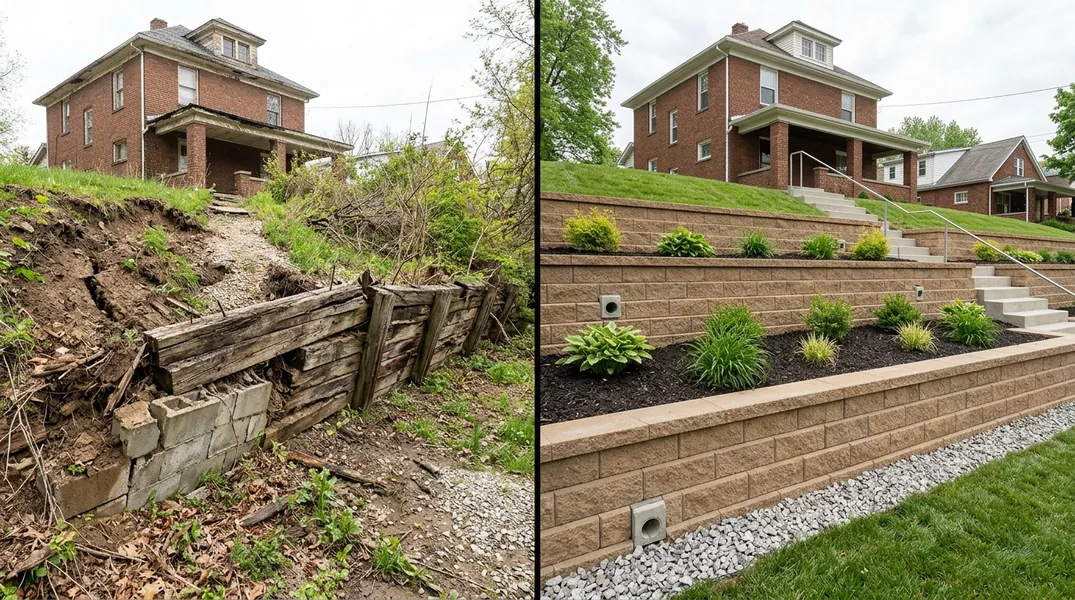
Even a well-chosen wall can run into trouble when the soil and water table work against it. If you notice bulging, leaning, cracking, or water pooling at the base of your wall after heavy rain, those are warning signs that the drainage or the structure itself is failing. In Northwest Ohio, these problems often trace back to clay soil that traps water and pushes against the back of the wall with tremendous force. Ignoring them usually makes the problem worse and more expensive to fix.
That is where Retaining Wall Repair comes in. A professional can inspect the wall, identify whether the issue is drainage, foundation, or material failure, and recommend a fix before a small problem becomes a collapse. In some cases, a wall is too far gone and Retaining Wall Replacement with a material better suited to our soil is the wiser investment. Either way, getting an expert opinion early protects your landscape and your home.
Retaining Wall Installation Cost in Toledo: What to Budget
Homeowners often ask what a retaining wall will cost, and the honest answer is that it depends on height, length, material, access, and how much drainage work is required. A short block wall along a garden bed is a very different project from a tall concrete wall holding back a steep slope near a foundation. In Northwest Ohio, the need for proper drainage gravel, footings below the frost line, and sometimes soil correction adds to the scope, and those details matter for a wall that lasts.
Rather than guessing, the best move is to get a free estimate based on your actual site. A local contractor can walk your property, evaluate the clay and water table conditions, and explain how each material affects the total. If you want to talk through your options right now, call Toledo Retaining Wall at (419) 574-6333. Choosing the right material from the start is the surest way to avoid costly repairs and enjoy a wall that stands strong through every Ohio season.
Looking for a professional retaining wall contractor in Toledo? Toledo Retaining Wall responds fast for all your retaining wall needs.
Get a Free QuoteOur services: Retaining Wall Installation · Retaining Wall Repair · Retaining Wall Replacement